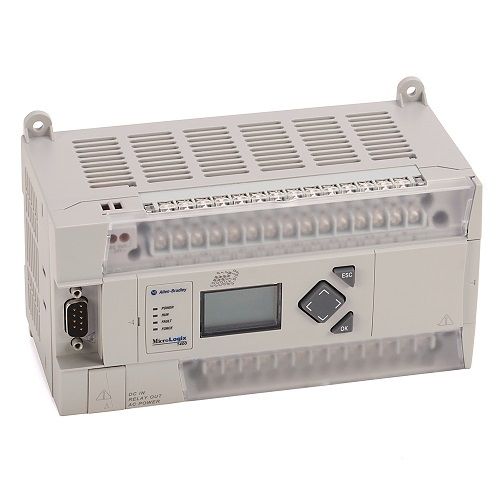
1766L32BWAA Allen Bradley PLC About
Brand:Allen-Bradley
Communication:DF1, DH-485, Modbus RTU, ASCII, DNP3, EtherNet/IP messaging, DNP3 over IP, Modbus TCP/IP
Depth:87
Display:Yes
Embedded Analog:(4) Voltage Inputs / (2) Voltage Outputs
Enclosure:IP20
Height:90
Input Signal:120 V AC
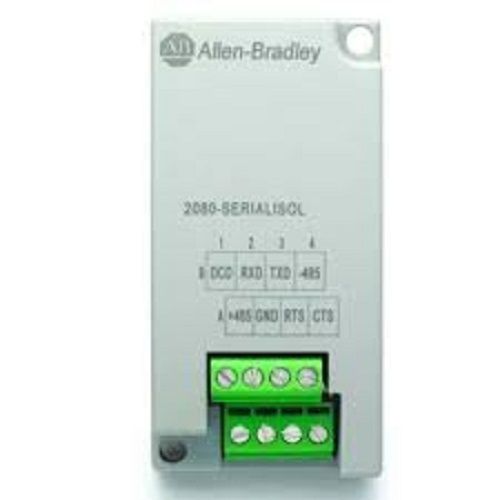
Interface:Ethernet Port, Isolated RS232/485 and Non-Isloated RS232C Serial Ports.
Memory:20 KB
Mounting:DIN Rail, Panel Mount
Number Of Channels:20 I/P, 12 O/P
Operating Temperature:-20... 60 C (-4...140 F)
Output Signal:Relay
Power Supply:120/240V AC
Special Features:Built-in RTC, Online Editing, 6 HSC, Up to 7 Expansion I/O
Standard:c-UL-us CL1DIV2, CE, C-Tick, KCC
Sub Brand:MicroLogix 1400
Type:Controller
Width:180
Versatile Connectivity and ExpansionThe 1766-L32BWAA offers multiple communication ports-including Ethernet, RS232/RS485 combo, and RS232 non-isolated-empowering seamless integration with existing networks and protocols. With support for up to seven 1762 expansion modules, this PLC provides the flexibility to expand I/O capacity as your automation needs evolve, making it suitable for both small- and medium-scale operations.
Designed for Industrial ReliabilityBuilt to withstand challenging environments, the MicroLogix 1400 features an IP20 rating, a functional earth connection, and can operate at altitudes up to 2000 meters. Its solid-state design safeguards against vibrations and humidity (5-95% non-condensing), and the operating temperature range of 0C to 55C ensures dependable performance across diverse applications.
User-Friendly Programming and UpgradesProgramming the 1766-L32BWAA is simplified via its Ethernet interface, supporting remote access and firmware upgrades. The LCD display allows direct monitoring and control, while the retentive memory and integrated real-time clock enable robust process scheduling, recordkeeping, and automation. High-speed counters and Boolean instruction processing add to operational efficiency.
FAQ's of 1766L32BWAA Allen Bradley PLC:
Q: How do I mount the Allen Bradley 1766-L32BWAA MicroLogix 1400 PLC?
A: You can install the 1766-L32BWAA using either DIN rail or panel mount options, ensuring flexibility in constrained or spacious control cabinets. Follow grounding requirements by connecting the functional earth for safe and reliable operation.
Q: What communication interfaces does the 1766-L32BWAA PLC support?
A: This PLC includes an Ethernet port, a RS232/RS485 combo port, and a separate RS232 non-isolated port. These support various protocols such as Modbus and DH485, enabling easy integration with industrial networks and external devices.
Q: When is firmware upgrading recommended, and how can it be performed?
A: Firmware upgrades are suggested when new features, security patches, or performance improvements become available. Upgrades can be accomplished remotely via the Ethernet port using the appropriate Allen Bradley tools and software.
Q: Where is the 1766-L32BWAA typically used, and what type of applications does it suit?
A: It is commonly deployed in factory automation, machine control, and process control applications. Its robust features and expandability make it ideal for industrial equipment monitoring and control in manufacturing settings, particularly in the United States.
Q: What are the main benefits of using this PLC for automation projects?
A: Key advantages include scalable expansion up to seven modules, fast input-to-output response times (<2 ms typical), high-speed Boolean instruction processing, integrated LCD for diagnostics, and reliable real-time operation even under challenging environmental conditions.
Q: How does the retentive memory and real-time clock enhance process automation?
A: The integrated retentive memory preserves user data and program status during power loss, while the real-time clock enables accurate scheduling, logging, and time-stamped automation for production and data tracking purposes.
Q: What sensors and input devices are compatible with the digital input specifications of this PLC?
A: This PLC supports digital input sensors operating at 24V DC. Each input point can handle a typical current of 8mA, making it suitable for connecting a wide range of industrial switches, proximity sensors, and other digital devices.





 Send Inquiry

