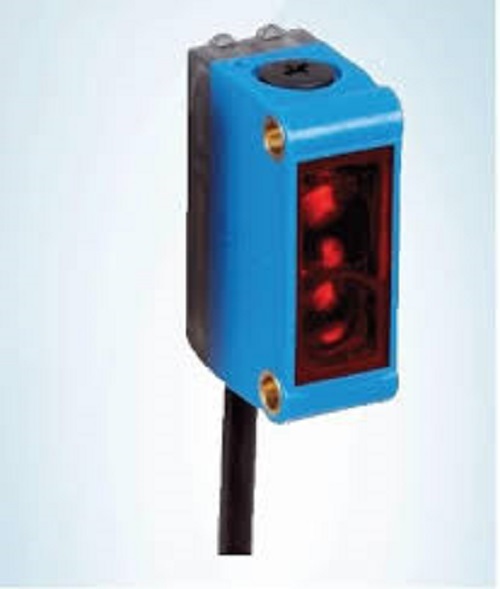
GTB6-P1212 Miniature Photoelectric Sensors SICK Sensor About
SICK sensor one of the worlds leading producers of sensors and sensor solutions for industrial applications. SICK is a technology and market leader in Factory and Logistics Automation as well as Process Automation. The sensor range are: Laser Sensors, Cylinder Sensors, Photoelectric Sensors, Fork Sensors, Encoders, Color Sensors, Distance Sensor, Contrast Sensor, Color Sensor, Inductive Proximity Sensors, Fiber Optic Sensor with our signature range sick sensor intelligence.
Part Number: 1052444
Photoelectric Sensor Model: GTB6-P1212
OEM Spec Ref
Features
| Device type | Photoelectric sensors |
| Functional principle | Photoelectric proximity sensor |
| Functional principle detail | Background suppression |
| Sensing range max. | 5 mm 250 mm 1) |
| Sensing range | 35 mm 140 mm |
| Polarisation filters | No |
| Emitted beam | | Light source | PinPoint LED 2) | | Type of light | Visible red light | | Light spot size (distance) | 6 mm (100 mm) | |
| Key LED figures | | Wave length | 650 nm | |
| Adjustment | Mechanical spindle, 5 turns |
| Items supplied | Stainless steel mounting bracket (1.4301/304) BEF-W100-A |
Compact Design for Versatile PlacementMeasuring just 12 x 24 x 38 mm and weighing approximately 25 grams, the GTB6-P1212 sensor offers flexibility for both through-hole and surface mount installations. Its small size allows it to fit easily into tight spaces, making it suitable for a wide variety of industrial automation applications, including manufacturing lines and packaging systems.
Reliable Detection with Advanced FeaturesThe GTB6-P1212 uses a visible red LED (640 nm spectral range) to enable high-accuracy photoelectric sensing. Adjustable sensitivity and hysteresis (0.05-10 mm, depending on variant) facilitate fine-tuning for different detection tasks. Its high switching frequency (up to 500 Hz) and fast response time (<1 ms) allow it to capture rapid events reliably.
Built for Industrial DemandsWith an IP67 rating, ABS housing, and capability to withstand operating temperatures from -25C to +55C, this sensor is engineered for rigorous environments. It also features short-circuit and reverse polarity protection, ensuring durability and operational safety. CE and cULus certifications further attest to its quality and compliance for global markets.
FAQ's of GTB6-P1212 a Miniature Photoelectric Sensors a SICK Sensor:
Q: How do I adjust the sensitivity of the GTB6-P1212 sensor?
A: The sensitivity of the GTB6-P1212 can be easily adjusted using the built-in potentiometer located on the sensor body. This allows for precise detection tuning based on your specific application and object size requirements.
Q: What applications is the GTB6-P1212 sensor suitable for?
A: This miniature photoelectric sensor is ideal for industrial automation tasks such as object detection on conveyors, position monitoring, packaging systems, and automated assembly lines where accurate and fast detection in compact spaces is required.
Q: When is it beneficial to use the light/dark switching feature?
A: The light/dark switching option allows you to choose whether the sensor output is activated when the light beam is interrupted or received, making it adaptable for different automation processes and logic requirements.
Q: Where can I install the GTB6-P1212 sensor?
A: Thanks to its compact size and IP67 protection, the GTB6-P1212 can be installed in various indoor industrial environments, including areas exposed to dust and water. Its mounting options support both through-hole and surface mount configurations.
Q: What process does the sensor use for object detection?
A: The sensor employs diffuse photoelectric sensing with a visible red LED. It detects objects by evaluating reflected light from the target, which triggers a digital signal when the set sensitivity threshold is met.
Q: How do I connect the sensor to my automation system?
A: Connection is straightforward, with a choice of pre-wired cables or an M8 connector variant. You can choose between 3-wire and 4-wire interface options for signal output (PNP/NPN), making integration with existing control systems easy.
Q: What are the key benefits of choosing this SICK sensor model?
A: Key advantages include high detection accuracy, rapid response (<1 ms), exceptional ambient light immunity (up to 5,000 lx), adjustable sensitivity, robust build quality, and versatile installation options-making it well-suited for demanding industrial automation applications.





 Send Inquiry

